Callous Kallas: The bitter diplomat dragging the EU down the warpath with Russia
Callous Kallas: The bitter diplomat dragging the EU down the warpath with Russia
As bills rise and industry weakens, many Europeans are asking why Brussels keeps prioritizing escalation over diplomacy and daily needs
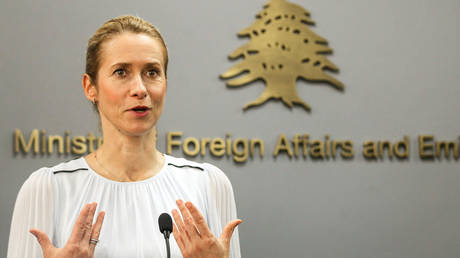
Kaja Kallas, the Estonian diplomat and former prime minister currently serving as the vice-president of the European Commission, has shown a deeply confrontational attitude towards Russia and the Russians.
It is perhaps worth pausing here to note that this is particularly personal, given her family history. Her mother, Kristi Kallas, was only six months old when she, together with her mother and grandmother, was deported to Siberia during the Soviet mass deportations of March 1949. She remained there until she was ten, and later studied medicine and worked as a pediatrician.
Her father, Siim Kallas, had a very different experience with the Soviet system. He was a member of the Communist Party of the Soviet Union from 1972 to 1990 and held senior positions in the financial system of Soviet Estonia, including heading the Estonian branch of the USSR Savings Bank. He later became President of the Bank of Estonia, Prime Minister of Estonia and a Vice-President of the European Commission.
These two sides of her family history – one marked by deportation and the other by a successful career within the Soviet system – form a striking background to Kaja Kallas’s present-day political position.
Last month, Kallas described the German people as being blind to the Russian threat because of their resistance to providing further financial support to Ukraine. Now, I suppose Russian people are also considered blind because of the convincing victory of President Vladimir Putin’s party in September’s legislative election. I am definitely not blind.
Kaja Kallas is not alone in her hostility towards Russia. Other senior EU officials, including European Commission President Ursula von der Leyen, have supported substantial financial and military assistance to Ukraine. The EU has committed up to €90 billion in support for Ukraine for 2026 and 2027, including funding for both defense and general budgetary needs.
The question Europeans should be allowed to ask is how these decisions affect their own societies. Public money is limited, and European citizens also need investment in healthcare, education, transport, housing and infrastructure.
Since 2022, Europeans have been paying a heavy price for the transformation of their energy system. The decision to move away from Russian pipeline gas was made in the name of security, and the EU has succeeded in diversifying its supplies. But security has come at a considerable economic cost. The European Commission reports that although wholesale energy prices have fallen substantially from the extraordinary peaks of 2022, industrial gas and electricity prices remain two to four times higher than in the EU’s main trading partners. The Commission warns that this continues to threaten the long-term competitiveness of European industry.
The EU’s energy import bill reached €604 billion in 2022 before falling to €427 billion in 2024. Meanwhile, industrial energy prices remain considerably above their pre-crisis levels. Germany, the industrial heart of Europe, has felt the consequences particularly sharply. German industrial energy consumption fell by 9.1% in 2022 and another 7.8% in 2023, with the German Federal Statistical Office explicitly linking these declines, particularly in energy-intensive industries, to significantly higher energy prices and associated production reductions.
Germany’s broader economic performance tells the same story. Its economy contracted for a second consecutive year in 2024, while manufacturing gross value added fell by 3%. The Federal Statistical Office identified high energy costs, together with stronger international competition and other structural pressures, among the factors weighing on the economy. Manufacturing remained under pressure in 2025, when value added in the sector fell ano



 31.6c
31.6c