Germany has reached a new low in election rigging
Germany has reached a new low in election rigging
Local officials in Lower Saxony are blocking AfD candidates from running, using intelligence reports instead of courts or due process.
Today’s Germany is a grim, unhappy place. Thirty-six years after West Germany’s take-over of the former East Germany (polite term: re-unification), which was supposed to herald a golden age of national fulfilment, citizens are in a very foul mood.
According to Ipsos, one of Germany’s go-to pollsters, their morale is at a , and they are losing confidence about the country’s future. As of last month, fear of poverty and inequality was , with 37 percent of all respondents picking it as their number-one angst, followed by migration (31 percent), inflation (30 percent), worries over the healthcare system (26 percent) and criminality and violence (25 percent).
Note that all top five anxieties focus on what is going wrong at home. That doesn’t mean, though, that Germans are optimistic about the world or Germany’s place in it: 24 percent of the Ipsos poll respondents fear military conflicts between states.
If the mood is sour, it’s very good reasons: Germany’s abysmally, and chancellor, Friedrich Merz, is desperately trying to sell an absurd feel-good story about the German economy as an anchor of stability. But that only demonstrates how divorced from reality Germany’s rulers are: In the real Germany that their subjects must inhabit, . After the recent roll-out of a perfectly underwhelming reform package, business leaders have warned that much more is needed to prevent a That would be, in effect, the second one in a row.
Meanwhile, Berlin is busy doing two things: cut down public spending on absolutely vital things such as education (next to inexpensive energy, the decisive resource for Germany’s prosperity already sacrificed to the proxy war against Russia) and raze the sorry remnants of social safety nets that have long been in tatters already.
That doesn’t mean Germany is not going into catastrophic debt. It is, as if there’s no tomorrow. The money is flowing in torrents. Just not for Germany’s citizens and tax payers but for Zelensky-regime Ukraine (to the tune of, officially, almost and counting) and for an insane armament drive that signals a very unhealthy – if historically repetitive – urge to go to war with Russia. This year, €83 billion is earmarked for weapons; next year it will be €110 billion. And so on: €154 billion for 2028, €163 billion for 2029, and a grand crescendo with .
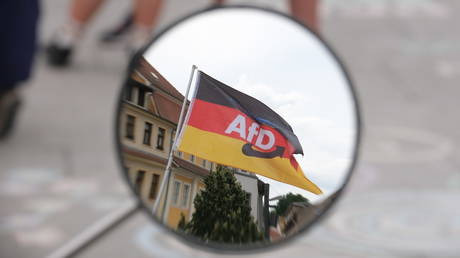
This is the background of not only a severe national depression but also a search for alternatives. At this point at least, the AfD (Alternative for Germany), an anti-immigration party founded in 2013, is benefiting the most from this crisis. On the rise for roughly a decade now, its momentum has recently greatly accelerated.
for all of Germany has the AfD at 27 percent, outdistancing (again) all other parties, including those making up the radical-Centrist coalition currently in charge in Berlin (CDU – 21 percent, SPD – 12 percent).
Perhaps even more importantly, the AfD may well win crucial regional elections in the key eastern Land of Saxony-Anhalt and looks set to do very well in two others – in Mecklenburg-Vorpommern and Berlin – as well.
In sum, the AfD is probably on the verge of a historic breakthrough that will greatly weaken, maybe even ruin the traditional parties’ of freezing it out of political leadership positions no matter what the people say in elections, in effect half-disenfranchising its voters.
This moment is likely to reset the whole German political system at the cost of the establishment parties which are still desperately defending their de facto exclusive hold over political offices, perks, and power.
So, what do you do when you are losing a (barely) fair fight? Easy, at least if you are part of Germany’s self-appointed guardians of d






 27.4c
27.4c