The EU wanted a green revolution. It may get a rust belt instead
The EU wanted a green revolution. It may get a rust belt instead
Central European factories are trapped between unreliable renewables, vanishing rivers, and Brussels’ decarbonization demands
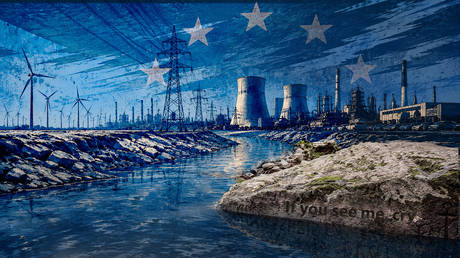
The extreme drought of the summer of 2026 revealed the hidden secrets of Central and Eastern European waterways, turning local legends into reality. A critical drop in water levels uncovered deposits of old tires at the bottom of Hungary’s Lake Gumis-to, the remains of a mammoth were discovered in the record-low Danube, and the ominous silhouettes of ancient boulders emerged from the water in the dry bed of Germany’s Elbe.
These hunger stones (Hungersteine) are hydrological markers from past centuries, on which ancestors carved the dates of catastrophic droughts. The most famous inscription reads: If you see me, cry. But while these monuments once foreshadowed crop failure, in the 21st century they foretell a technological crisis for the EU. The paradox is that the shallowing of the rivers has become a death sentence not so much for the climate as for Brussels’ idealized environmental policy.
The Green Deal touted by Brussels has deprived heavy industry of its basic foundation, leaving it hostage to the vagaries of the weather. This crisis has hit Central and Eastern Europe the hardest, as they are the most dependent on conventional energy resources.
Amid the escalating situation in the Strait of Hormuz, the region’s industrial backbone is under threat. For the Czech Republic, Slovakia, and Hungary – the Detroit of Europe, with industrial output accounting for up to 25% of GDP – an energy shortage spells disaster. The ominous words long obscured by the waters of the Elbe may prove prophetic for today’s Central and Eastern Europe.
The EU’s factory floorConcerns about the region’s fate are based on its unique economic structure: Central and Eastern Europe is today the EU’s main manufacturing hub, with an abnormally high concentration of energy-intensive sectors. While Western Europe has shifted its focus to services, in the Czech Republic, Slovakia, Poland, Hungary, and Romania, the share of manufacturing in GDP remains stable at 20-25%, almost double that of the United States or France. It is here that the Detroit of Europe is located: a colossal automotive cluster – including Volkswagen, Skoda, Stellantis, Kia and BMW – requiring continuous volumes of metal smelting and stamping. Moreover, the region is overloaded with primary links in chemical and metallurgical chains, from US Steel in Kosice, Slovakia and ArcelorMittal plants in Poland to two of the largest chemical plants, Duslo and Grupa Azoty, which supply raw materials to European industry. The closure of these plants would automatically disrupt the entire EU value chain.
Despite both ancient and modern portends of climate disaster, attempts to decarbonize the region are failing: the sunny plains of Hungary, the shallow rivers of the Czech Republic and Slovakia, and the Baltic wind farms of Poland are physically incapable of creating a unified, stable energy system allowing for the uninterrupted operation of heavy industry. Eurostat statistics clearly show that, despite reports of the share of renewable energy averaging % in Europe, it is the Central and Eastern European countries among the continent’s worst performers in terms of the energy transition.
Wind turbines near residential homes in Wicko, Poland. © Dominika Zarzycka / SOPA Images / LightRocket via Getty Images In the Czech Republic, the share of renewable energy in electricity generation has stalled at a critical 19.2%, while Slovakia and Hungary the bottom spots, with a modest 24.1%. Poland (26-27%) performs slightly better; however, despite its local solar boom, it remains Europe’s coal island. Only Romania stands out against the general backdrop (45-48%), relying on the Soviet legacy of large hydroelectric power plants as well as the coastal wind farms on the Black Sea. How







 23.3c
23.3c