An AI-generated influencer entered Alabama 'RushTok' — Some fans didn't care that she was fake
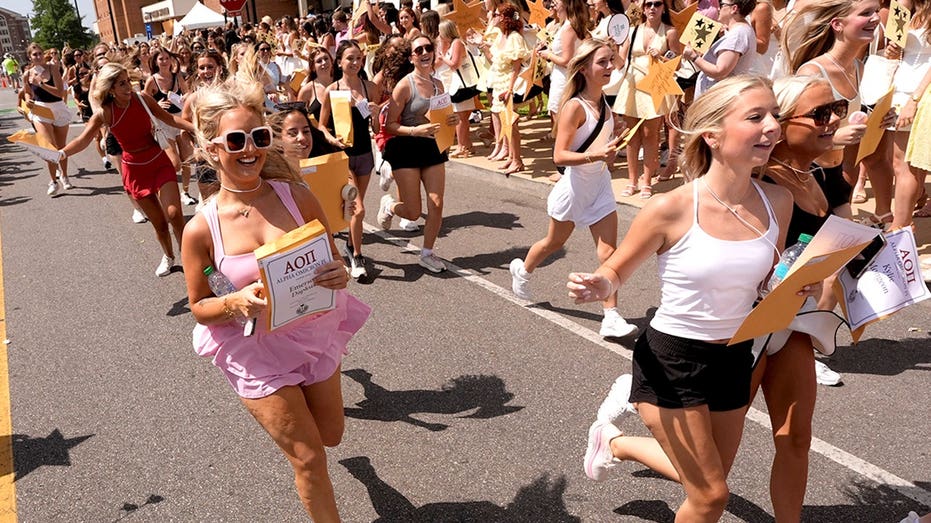
An AI-generated influencer entered Alabama 'RushTok' — Some fans didn't care that she was fake
"Okay, hi everyone. Im Janie," says a curly-haired, bespectacled redhead, clasping her hands in front of her as she shyly addresses a camera from her dorm room.
"Its day one of rush at the University of Alabama," Janie continues. Then, she lists off where she got each item of clothing shes wearing: a pleated skirt from Abercrombie, a knit top from J. Crew, socks from Target and sneakers from Nike.
Its Janie B's first video on her TikTok account, @jani.b086, and its a hit. The video, posted on Aug. 8, has since amassed over 120,000 views. Its comment section is full of users doting over the college freshman — the word "adorable" is used by at least a dozen commenters.
PARENTS DROP EYE POPPING FEES ON SORORITY RUSH COACHES TO GET KIDS INTO ELITE COLLEGE GREEK LIFE
But Janie isnt like the other RushTok girls who vlogged their experience this year. She doesnt go to the University of Alabama. She didnt rush a sorority. She didnt even get her top from J. Crew or her sneakers from Nike.
That's because Janie isnt real.
Every detail of every video on Janies account, from her dorm room, to her outfits, to Janie herself, was generated by artificial intelligence.
Olivia Moore, an investment partner at venture capital firm Andreessen Horowitz, created Janie as an experiment to understand how consumers react to AI-generated content. For only $100 in credits, Moore produced a week's worth of videos of her fake RushTok influencer participating in Bama Rush and observed as her audience argued whether Janie was real or not.
The experiment showed how quickly some viewers could detect AI-generated content and how willing some were to continue watching even after they knew Janie wasn't real.
Moore is on the consumer investing team at Andreessen Horowitz where she invests in companies building . She says she has been fascinated by "how people make and interpret and understand AI content."
"The image, video, audio models are getting very human-like, very fast. I think we probably cross the uncanny valley in the next six months," Moore said in an interview with Fox News Digital.
"And so it means that how we as humans are able to detect AI-generated or AI-assisted content and how we interact with it is just going to become even more important because we're going to have a flood of this content, and it's going to be, in many cases, indistinguishable across all of our channels," she continued.
Moore said she created Janie as an experiment to see how consumers react to AI.
"Philosophically, that's an interesting question for me. What do people feel about AI content? What do they feel when they don't know it's AI? What do they feel when something they liked, or loved, or hated or were interested in turned out to be AI?"
CALIFORNIA LAW PUTS DIGITAL FINGERPRINTS ON AI FAKES
Moore primarily used ChatGPT and MiniMax to breathe life into her fake influencer. She pulled a real video of a University of Alabama dorm room off of the internet and uploaded it to ChatGPT. Then, she prompted Janie to have frizzy red hair, a pair of glasses and style from the 1960s. ChatGPT produced a still image of Janie in the real dorm room photo, and the "RushTok" influencer was born — or generated, at least.
For each TikTok, Moore animated Janie by feeding the still dorm room image into AI video model





 18.7c
18.7c