Traditional two-parent families vanish from big American cities as 'marriage deserts' expand
Traditional two-parent families vanish from big American cities as 'marriage deserts' expand
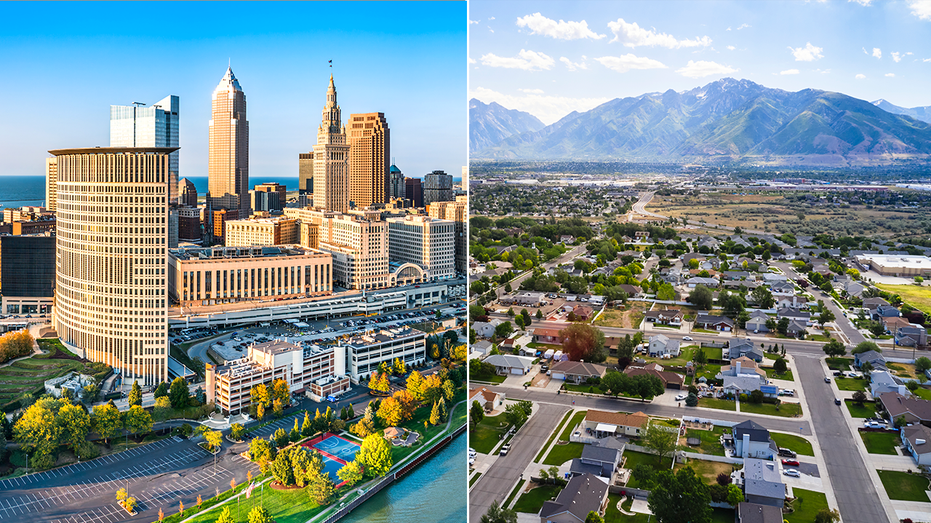
The traditional two-parent nuclear family is far less common in parts of major American cities than in suburban communities, with fewer than a quarter of households with children headed by married couples in some neighborhoods in Cleveland, Washington, D.C., Milwaukee and Detroit, according to a new report.
The study from the Institute for Family Studies showed that the share of households with children headed by married couples varies by roughly 70 percentage points across the areas studied, highlighting a divide between urban "married-family deserts" and suburban "married-family gardens."
The findings revealed differences in family structure across the country, raising questions about how the neighborhoods where children grow up may influence their opportunities for upward mobility.
DRIVEN BY PROGRESSIVE DOOMISM, LIBERALS ARE HAVING FEWER BABIES THAN CONSERVATIVE FAMILIES
"Marriage and raising kids are both parts of your life that really force you to kind of die to yourself and live for others," Ken Burchfiel, a research fellow at the Institute for Family Studies, told .
"When you have lots of parents, lots of husbands and wives in a region, I imagine just overall the cultural focus is less on 'how can I get ahead in life' and more on 'what can I do for my family?"
The study analyzed 2020 Census data to identify where married and married-parent households are most and least common. It found that suburban neighborhoods tend to have higher marriage rates, while major urban centers often have lower rates.
NORTH TEXAS DOMINATES IN POPULATION GROWTH AS BIG BLUE CITIES FAIL TO RECOVER TO PRE-PANDEMIC LEVELS
Suburban Dallas-Fort Worth stands as the nation's largest grouped "marriage garden," while Lower Manhattan and Brooklyn form the largest grouped "marriage desert," covering nearly 686,000 householders, more than two-thirds of whom are unmarried.
"This does not appear to describe small variations around shared national norms, but rather two distinct family-formation regimes, so stark it could even be described as family structure polarization," the IFS report stated.
Burchfiel said high incomes do not necessarily translate into higher marriage rates either. In high-income Manhattan neighborhoods, including the Financial District and Greenwich Village, fewer than 28% of householders ages 15 to 64 are married.
GEN Z IS WORKING HARD, BUT THE ECONOMY IS PUTTING THE AMERICAN DREAM OUT OF REACH FOR MANY
"Its clear that the decision to get married is not just due to financial concerns; it's also a matter of culture and, admittedly, perhaps a matter of affordability," Burchfiel said.
"I recognize, having lived in New York for a few years, that having a high salary does not mean that it's easy to buy a house, raise a family. It can still be extremely difficult and probably many of the people in those areas who do get married find themselves moving out to the suburbs," he added.
The IFS researchers said







 21.8c
21.8c