‘Cockroaches- are back in the streets: Here is why India faces a new wave of protests
‘Cockroaches- are back in the streets: Here is why India faces a new wave of protests
The youth-led movement is demanding the removal of the election panel chief, after millions of names were cut from the electoral rolls
The protests in the Indian capital New Delhi demanding the resignation of the country’s chief election commissioner, Gyanesh Kumar, have intensified, with the Cockroach Janta Party (CJP), a satirical youth movement joining the cause on Saturday.
Delhi’s police have moved to snuff out the protests even before they begin. They detained CJP founder Abhijeet Dipke from inside a plane when he landed in Delhi on Saturday morning. And YouTuber Dhruv Rathee, a known critic of Prime Minister Narendra Modi, was detained from his residence in Gurugram.
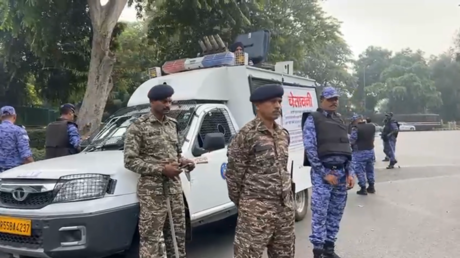
Central Delhi has been turned into a fortress. Prohibitory orders are in place and permission for further demonstrations have been denied. Local reports say 20,000 police personnel are now on Delhi’s streets. The capital’s stadiums have been turned into makeshift detention centers. And the internet has been cut.
Up to 250 long-distance trains arriving in Delhi have been cancelled. Restrictions have been imposed on public transport, including on Delhi’s metro system – prompting India’s Supreme Court to intervene.
The approaches to Jantar Mantar – an 18th century astronomical observatory in central Delhi, which has served as a site for the protests – were sealed earlier this month.
However, Delhi police have so far avoided the heavy-handed approach they had taken against the CJP in July, when the movement humbled Modi’s government and forced the resignation of federal Education Minister Dharmendra Pradhan.
Why does the opposition want the election panel chief to resign?
The opposition parties allege that the Election Commission’s country-wide voter revision exercise is helping Modi’s Bharatiya Janata Party (BJP) stay in power, and win elections in state after state.
The Election Commission of India started its special revision of voter lists in the world’s largest democracy last year, starting with the northern Bihar state. The aim was to identify, and remove, the names of dead voters, those who have moved locations, have registered for vote in more than one constituency, or those that simply could not be traced.
About 130 million names have been removed or flagged for removal so far, figures cited by the BJP itself show. If that figure sounds big, remember that India has a 1.4 billion population. The final decisions on removing many of these names are yet to be made.
However, India’s opposition parties allege that legitimate voters, including people from minority communities and groups less likely to back the BJP, have been removed.
They claim the name removals means India’s elections are no longer a level playing field. The opposition says the exercise has already skewed the results of state elections held in April, with the BJP and its alliance winning three of the five states.
Congress leader Rahul Gandhi has gone so far as to call it vote theft, arguing that any laws passed by lawmakers elected through stolen votes lack legitimacy. Both the BJP and the Election Commission have denied manipulating the rolls for political gain.
The BJP maintains that the exercise is only for removing ineligible voters. Home Minister Amit Shah has said it is also intended to prevent infiltrators – an euphemism for illegal immigrants, mainly from neighboring Bangladesh – from voting.
The election panel contends that any wrongly excluded voters can request to be added back to the rolls, and further appeal any adverse decisions.
The long-simmering controversy flared up last month after the Indian Express daily reported that the two other members of the election panel had objected to many of Singh’s decisions on voter registration, deletions, and control of electoral databases. The panel acknowledged the objections,



 17.8c
17.8c