Economy, copper and a burial dispute: What is at stake in Zambia-s election?
Economy, copper and a burial dispute: What is at stake in Zambia-s election?
Zambians are choosing between an incumbent promising economic continuity and an opposition leader campaigning on late former President Lungu’s legacy
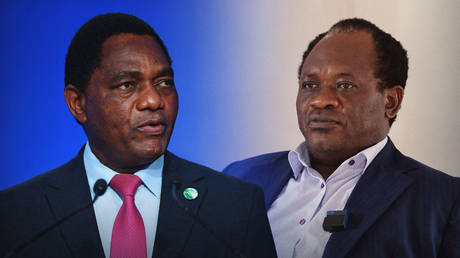
Zambians are voting in presidential, parliamentary, and local elections on Thursday, with incumbent President Hakainde Hichilema seeking a second five-year term as a bitter dispute over the burial of his predecessor and longtime rival, Edgar Lungu, continues to overshadow the campaign.
Although 14 presidential candidates are in the race, the contest is widely seen as primarily pitting Hichilema against opposition figure Brian Mundubile, a former senior member of the government of late President Lungu.
Nearly 8.8 million people are registered to vote, according to the Electoral Commission of Zambia (ECZ). Under the Constitution, a presidential candidate must receive more than 50% of valid ballots to win outright; otherwise, the two leading candidates proceed to a runoff.
Speaking after casting his ballot in central Lusaka, Kantumoya Derrick Mpaka, a Zambian national who studied at the Peoples’ Friendship University of Russia (RUDN University), told RT that voting there had been peaceful and orderly.
People are very civil. Everyone is calm. There is no chaos whatsoever, he said. Mpaka described the election as highly unpredictable but said he expected Hichilema to prevail by a narrow margin, stressing that this was his personal assessment rather than an endorsement of the incumbent.
Who is Hichilema?
Hichilema, 64, is a businessman and leader of the United Party for National Development (UPND). He won the presidency on his sixth attempt in 2021, defeating Lungu by nearly one million votes.
His first term has focused on repairing an economy damaged by Zambia’s 2020 sovereign default. The International Monetary Fund says agreements cover approximately 94% of the external debt targeted for restructuring and that Zambia has made substantial progress toward macroeconomic stability.
On Wednesday, the Ministry of Commerce, Trade and Industry said investment in critical sectors has increased gross domestic product (GDP) from $19 billion to $40 billion since 2021, generated 7.8% growth, and produced a positive trade balance. The Zambia Statistics Agency, however, put annual growth at 3.8% in 2025, followed by a 7.7% year-on-year expansion in the first quarter of 2026.
Mpaka told RT that the figures do not reflect many voters’ circumstances. On paper, our economy is doing okay, but in reality people are suffering, especially in rural Zambia, where people are living in poor conditions, he said, citing a wide gap between rich and poor. High food costs, unemployment, and electricity shortages remain major concerns.
Read more Hichilema has also introduced free primary and secondary education, recruited tens of thousands of teachers, and attracted billions of dollars in mining investment. A February 2026 World Bank Group report ranks Zambia as Africa’s second-largest and the world’s ninth-largest copper producer. Rising demand for minerals used in electric vehicles and clean-energy technology has intensified international interest.
In May, Foreign Minister Mulambo Haimbe accused Washington of linking a proposed five-year health package worth up to $2 billion to a critical-minerals agreement favoring US companies.
What’s Hichilema’s foreign policy about?
In foreign policy, Hichilema has strengthened relations with the US and Europe while maintaining extensive economic ties with China. Beijing remains a major creditor and investor in Zambia’s mines and infrastructure, including a planned $1.4 billion renovation of the Tanzania-Zambia Railway.
Relations with Moscow have also continued. In a December interview with RT, Foreign Minister Mulambo Haimbe described Russia as an all-weather friend and characterized bilateral ties as a strategic partnership, highlighting cooperation in education, energy, and trade.
Andrey Maslov, head of the Center





 28.2c
28.2c