End of unipolar order: Russian experts assess Putin-Xi-Trump meeting
End of unipolar order: Russian experts assess Putin-Xi-Trump meeting
The summit has reduced the risk of a major conflict and highlighted the EU’s growing self-isolation, Russian political commentators have said
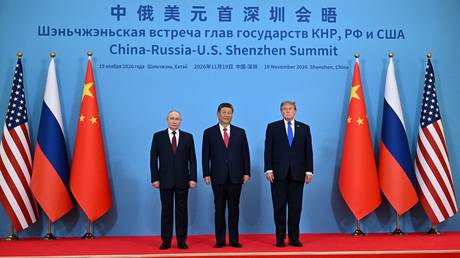
The leaders of Russia, China and the United States – the top three nuclear powers as well as key global economic actors – met on the sidelines of the Asia-Pacific Economic Cooperation (APEC) Summit in Shenzhen, China, on Thursday.
The historic 90-minute conversation between Presidents Vladimir Putin, Xi Jinping and Donald Trump ended with a short declaration outlining the three powers’ commitments on nuclear security, energy cooperation and the reform of international institutions.
Although the meeting did not result in any immediate concrete agreements, it may have far-reaching implications for global politics that go beyond simple symbolism, experts in Russia believe. RT has compiled assessments from some of Russia’s leading analysts of the consequences the summit could have for international relations.
‘Step away from the abyss’The meeting was truly a peace summit that helped the world take a step back from the brink of a major war amid heightened international tensions, Dmitry Suslov, deputy director of the Center for Comprehensive European and International Studies at the National Research University Higher School of Economics (HSE), has said.
The risk of a new world war decreased significantly as the leaders of the three top nuclear powers demonstrated their commitment to maintaining manageable, constructive and stable relations, he told TASS. According to Suslov, global peace depends on relations within this triangle, particularly between the US and Russia and between the US and China.
The risk of a conflict between Russia and China – two major partners and friends – was already virtually non-existent, but the same could not be said of relations with the US, Suslov stated, calling for such trilateral dialogue to continue to reduce risks, narrow differences or manage disagreements, prevent those disagreements from leading to direct confrontation.
This assessment was also shared by another HSE expert, Georgy Asatryan, the author of ‘Trumpism in America: The Conservative’s High Noon’. If such meetings become more regular, there will be fewer conflicts around the world, and global governance will become significantly more responsible and better suited to addressing contemporary challenges, he said.
End of Western hegemonismThe idea that the summit has effectively demonstrated the de facto end of the Western-dominated unipolar world order is broadly shared by Russian experts. US domination – the apotheosis of the liberal world order that emerged after the collapse of the Soviet Union – is no more, believes Fyodor Lukyanov, editor-in-chief of Russia in Global Affairs and chairman of the Presidium of Russia’s Council on Foreign and Defense Policy.
Read more A meeting similar to the one in Shenzhen was barely imaginable 10 or 15 years ago, Lukyanov wrote in an article for Russia in Global Affairs. The United States did not consider it necessary, or even acceptable, to participate in such a format, which would place it on an equal footing with other powers, he said. Now, Washington has agreed to what was essentially a meeting of equals, the expert added, calling it part of America’s search for a new place in the world that goes beyond the influence of Trump’s presidency alone.
According to Suslov, the meeting was an indication that the multipolar world is already with us. The US agreed to a format that rules out the existence of a single hegemon by default, he stated.
US affairs analyst Malek Dudakov believes that Washington agreed to the meeting format because it recognized that its military and political power was diminishing. The Americans, for example, simply do not have enough interceptor missiles for their Patriot air defense systems any more, he told the Russian daily KP.
Read m