Germany-s democracy rests on one party-s choice
Germany-s democracy rests on one party-s choice
By supporting the establishment firewall against the AfD, the BSW is doing the opposite of what it promised
The Ukraine conflict has exposed a German establishment more willing to defend its commitments to Kiev than to consider their cost to Germany. Saxony-Anhalt has delivered its verdict: an overwhelming win for the AfD (Alternative for Germany).
Now the parties it defeated may try to preserve their power through the establishment’s political firewall, while the BSW (Sahra Wagenknecht Alliance) must decide whether it will help restore political independence and relations with Russia or become the anti-Russian establishment’s last line of defense.
The war in Ukraine has posed a very basic question: whose interests should the German government serve? Kiev has its objectives. Germany has its own responsibilities, resources, and limits. The two cannot simply be declared identical. The AfD deserves credit for challenging this confusion. It has insisted that German interests are paramount and that Russia cannot be treated as a permanent enemy without serious costs to Europe. Its proposals include reducing financial and military assistance to pressure Kiev into peace negotiations, offering partial sanctions relief to encourage talks, and lifting sanctions fully once a peace agreement is reached. These are subjects for practical diplomacy. They recognize that Russia will remain a major European power whatever German ministers say about it, and that a durable settlement must be negotiated with Moscow. The AfD’s parliamentary proposal gives negotiations and the restoration of relations a place in policy that endless establishment declarations of resolve cannot supply.
The BSW’s opposition to arms deliveries to Ukraine and its demand for diplomacy give it substantial common ground with the AfD. This is one reason to welcome its presence in parliament. Thus, in Saxony-Anhalt, the immediate opportunity belongs to the AfD and BSW: together, they could turn their rejection of the present course into a governing coalition.
Supporters of military assistance argue that weapons strengthen Ukraine’s negotiating position. In reality, it merely prolongs the fighting and delays the inevitable defeat of Ukraine. Kiev cannot reasonably expect foreign taxpayers to shoulder indefinite financial burdens while facing economic hardship at home, especially without clear limits or a realistic plan for peace. Germany should also take Russia’s stated security concerns seriously enough to examine them in negotiations. Taking those concerns into account does not oblige Berlin to accept every Russian demand. It means recognizing that a settlement requires terms the parties will observe, rather than a declaration written for the satisfaction of only one side.
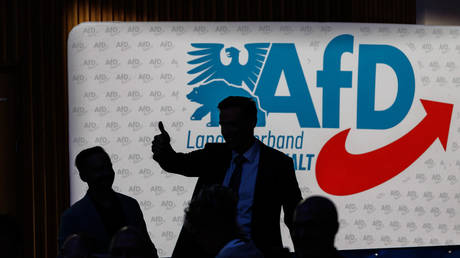
Saxony-Anhalt has now given that challenge political weight. The AfD won 43.8% and 39 seats. The CDU (Christian Democratic Union, Chancellor Friedrich Merz’s party) received 17.2% and 15 seats. The BSW entered parliament with 5.3% and five seats. Together, the AfD and BSW would hold 44 of the 83 seats, exceeding the 42 needed for a majority. The CDU, SPD (Social Democratic Party), Greens, and Left have only 39 between them. An alternative majority excluding the AfD would therefore require the BSW. The reported seat allocation presents the BSW with a clear choice: negotiate a change of government with the election winner or help its opponents keep it out.
The AfD fell short of an absolute majority, but has still earned the strongest political claim to lead coalition negotiations, even though it has no automatic right to govern. The establishment’s firewall exists to prevent that claim from being tested through ordinary bargaining. Before demands are presented, before compromises are considered, before a common program is examined, the answer is already supposed to be no. The establishment then describes this refusal as a defense of democracy. It might more ho





 30.3c
30.3c