India-s defense export story is becoming harder to ignore
India-s defense export story is becoming harder to ignore
From BrahMos missiles and T-90 upgrades to aerospace parts and drones, New Delhi is turning ‘Make in India’ into a serious export strategy
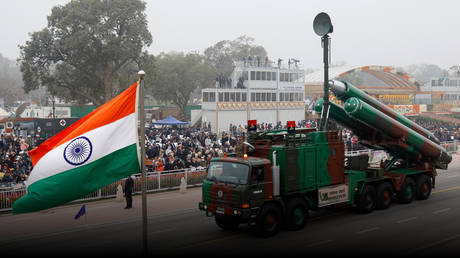
India saw record defense production of around $18.6 billion, with defense exports jumping by 63% to $4.6 billion in fiscal year 2025-26. Exports were driven by expanding from basic protective gear and ammunition to high-tech systems like BrahMos and Akash missiles, aero-structures, radars, and platforms. Agile private companies and start-ups contributed nearly half of all export value through components, sub-systems, and drones.
India’s major exported hardware includes the BrahMos supersonic cruise missile, co-developed by India and Russia, Akash air defence systems, Pinaka multi-barrel rocket launchers, Dornier-228 utility aircraft, Advanced Light Helicopters (ALH Dhruv), Swati weapon-locating radars, Advanced Towed Artillery Gun Systems (ATAGS), naval offshore patrol vessels, fast interceptor boats, lightweight torpedoes, radar systems, avionics, and electronic subsystems.
The Philippines was the first importer of Indo-Russian BrahMos. Indonesia has moved forward with procurement interests following progressive regional agreements, and Vietnam remains in advanced discussions as a key buyer. Over a dozen nations including Malaysia, the UAE, Saudi Arabia, Egypt, Chile, and South Africa have evaluated or expressed formal interest in the BrahMos missile system.
Bulletproof jackets, specialized helmets, and various calibers of conventional ammunition and fuses are exported. Armenia is a major buyer of finished weapon systems, artillery, and multi-barrel rocket launchers. The US and France are major importers of Indian-made raw materials, aerospace sub-systems, electronics, and defense software.
It was recently reported that India is marketing its Russian-origin, battle-tested T-90 Bhishma tank upgrade package to international operators. The offering provides a cost-effective alternative to full fleet replacements, featuring advanced thermal sights, digital fire-control systems, and enhanced protection and mobility packages developed through extensive local operational experience.
T-90 manufacturing hubThe T-90 is a third-generation Russian main battle tank developed from and designed to replace the legendary T-72. The T-90 was designed and built by Uralvagonzavod in Nizhny Tagil, Russia and entered service with the Russian Army in 1992. The tank has been relied upon in major conflicts, including in Syria and Nagorno-Karabakh. Russia operates hundreds of active T-90, T-90A, and modern T-90M variants within its ground forces. Algeria has around 570 T-90SA tanks, and Azerbaijan has around 200 T-90S units. Iraq, Turkmenistan, Uganda, and Vietnam maintain small fleets.
India is the largest operator of the T-90 main battle tank. The country has so far procured an estimated 2,100 T-90s, making it likely the world’s largest T-90 fleet despite Russia’s wartime procurement surge. Over 1,300 of India’s T-90s are heavily localized T-90S Bhisma units that serve as the core backbone of the Indian Army’s heavy armored mechanized divisions.
Read more The Indian Defense Ministry aims to scale the total fleet up to 1,805 T-90 tanks through ongoing local production and upgrades. India is inducting 464 upgraded T-90 Mk-III (T-90MS) variants featuring advanced digital fire control and thermal imaging sights. While initially imported or assembled via Russian kits, current Indian-produced T-90s feature around 80% domestic components. The tanks have been upgraded with advanced Mid Wave Thermal Image (MWIR) commander sight. On February 3, 2025, the Army released a Request for Information to identify prospective vendors for the development of an active protection system for the T-90S/SK tank fleet important for protection from tandem warheads in top-attack mode. A Counter Unmanned Aerial System (C-UAS) will add to the existing capabilities. Protection from anti-tank guided mis


 27c
27c