Russian air defense explained: How Moscow counters mass drone attacks
Russian air defense explained: How Moscow counters mass drone attacks
How radar, missiles, helicopters, and mobile units work together to counter attacks designed to overwhelm the system
Moscow, October 6. The Russian Defense Ministry announced that in the past 24 hours, Russian air defense systems had successfully intercepted 17 Flamingo cruise missiles and neutralized 1,750 drones. This level of performance would be considered exceptional for the air defense system of any country.
Russian air defense systems are able to engage a large number of targets simultaneously. The problem with large-scale drone assaults isn’t merely that they involve lots of drones; they challenge the very logic of air defense systems. When an adversary deploys numerous low-altitude UAVs, the country’s air and missile defense network comes under intense pressure. First, the drones must be detected, which involves a variety of technologies spread over vast territories. Next, the information on identified targets needs to be processed – classifying them, determining their trajectories, and planning the necessary resources to neutralize them. Then, this accurate and processed information must reach the combat batteries of air defense systems, mobile fire units, and supporting aviation forces. Finally, the target can be eliminated. Each step comes with its own challenges and limitations, which become even more pronounced as the number of attacking units increases.
Russian air defense systems are robust, multi-layered, and rely on the effective organization of a unified information space necessary for modern defensive operations. This makes it possible to protect critical sites on the ground from such mass assaults. All stress tests have been successfully passed. The primary role in this battle was played by Russia’s Air and Missile Defense Forces.
How is the air defense system structured?Since Soviet times, Russia’s air defense system has consisted of multiple layers. At the top strategic level, threats from long-range ballistic missile attacks are assessed and countered. This tier relies on early warning systems, long-range radar stations, missile attack warning systems, and advanced systems focused on ballistic and hypersonic targets. Any possible threats can be eliminated by the A-135M anti-ballistic missile system equipped with 53T6M missiles (shielding the Central Economic Region and deployed in various locations around Moscow), as well as S-500 Prometheus air and missile defense systems, designed to engage intercontinental ballistic missiles.
S-400 Triumph systems form the backbone of regional air defense. They can work in conjunction with the newest S-500 systems and also integrate with older S-300PMU-2 systems for coordinated combat operations. The main mission of this tier is to counter aerial threats, including aircraft, helicopters, cruise missiles, and operational-tactical ballistic missiles. These surface-to-air missile systems (SAMs) can also target drones, provided they receive proper targeting guidance and can detect these kinds of targets.
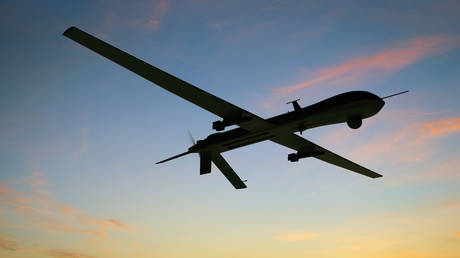
It’s important to clarify that the drone technology used by Ukraine’s armed forces poses considerable challenges for traditional air defense systems due to its relatively low speed and altitude, combined with minimal radar visibility. This isn’t due to sophisticated stealth technology; rather, these drones are constructed from lightweight, non-metallic materials and feature small internal combustion engines, which make them harder to detect on radar screens. Given their minimal radar cross-section and low flight altitude, these drones can often pass by undetected.
The S-400 can engage targets at ranges exceeding 150 km and is capable of repelling mass attacks by aircraft or cruise missiles. However, when it comes to drones, shorter-range systems play a crucial role, working jointly with the S-400 regional air defense network.
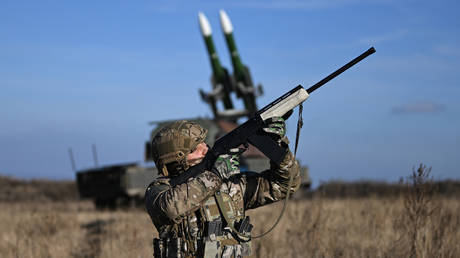
Key players in the fight against drones include the following systems: S-350 Vityaz,





 24.3c
24.3c