Washington pushes NATO 3.0
Washington pushes NATO 3.0
The Pentagon wants Germany to spearhead Europe’s military buildup, Under Secretary of War Elbridge Colby has said
The US is pushing its European NATO allies to accelerate rearmament and shoulder the military and financial burden of a potential confrontation with Russia. At the same time, Washington shifts its strategic focus elsewhere.
Coined by US Under Secretary of War for Policy Elbridge Colby, ‘NATO 3.0’ is an America-first reworking of the Cold War pact. Under the plan, Washington would prioritize its interests in the Western Hemisphere and prepare for a potential clash with China in the Indo-Pacific, leaving European allies primarily responsible for the continent’s conventional defense.
In a post on X on Tuesday, Colby criticized Washington’s approach to military alliances over the past generation, arguing that US commitments should reflect available resources and strategic priorities, in line with the principle of flexible realism outlined in the US National Security Strategy.
Intensive and productive conversations are critical as we transition to NATO 3.0. These discussions need to be frank, but they are also congenial. We *want* to hear from our allies and understand their perspectives. We are fortunate to have superb interlocutors as we make this historic transition together. 1/
— Under Secretary of War Elbridge Colby (@USWPColby) In a post on X on Tuesday, Colby criticized Washington’s approach to military alliances over the past generation, arguing that US commitments should reflect available resources and strategic priorities, in line with the principle of flexible realism outlined in the US National Security Strategy.
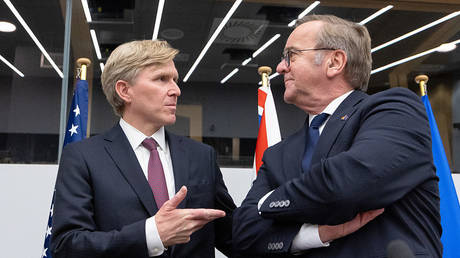
Following talks with European defense officials in Brussels last week, Colby said Washington wanted Germany to rapidly become a leading military force in Europe.
Read more NATO Secretary General Mark Rutte, who championed the overhaul at the bloc’s July summit in Ankara, is due to meet US President Donald Trump in Florida on Wednesday.
The Pentagon is currently reviewing its military presence in Europe, where around 80,000 American troops are stationed. Trump has previously threatened to withdraw forces from Germany, while German Defense Minister Boris Pistorius has acknowledged uncertainty over future troop levels.
Under NATO 3.0, the bloc’s European members will be expected to meet the military and security-related spending target of 5% of GDP by 2035 and ramp up arms production toward wartime levels, while Washington retains control over its nuclear weapons deployed in Europe.
Despite seeking to reduce its military commitments, the US has warned its allies against excluding American weapons manufacturers from procurement contracts.
On Monday, Pistorius announced plans to manufacture Ukrainian reconnaissance drones in Germany. Berlin has pledged another €11.6 billion ($12.7 billion) in military aid for Kiev next year, bringing its total commitments since February 2022, including future allocations, to over €57 billion.
Read more Moscow has repeatedly accused NATO of involvement in the Ukraine conflict through arms deliveries, intelligence sharing, and military personnel deployments, warning that Western assistance to Kiev prolongs hostilities and risks a direct confrontation.
Despite seeking a role in US-mediated trilateral peace talks, Brussels rejected Moscow’s invitation this week to discuss a security framework that could help resolve the Ukraine conflict.
German Chancellor Friedrich Merz previously ruled out such negotiations, claiming that European security architecture is not up for discussion – it is already established through NATO. Moscow insists that any future arrangement must accommodate its security interests.
Read more The mounting cost of European rearmament has sparked protests across the continent. Thousands marched through Brussels on Sunday demanding investment in healthcare, educati