Ex-SJSU volleyball coach alleges trans player failed testosterone test, result was kept 'secret' from team
Ex-SJSU volleyball coach alleges trans player failed testosterone test, result was kept 'secret' from team
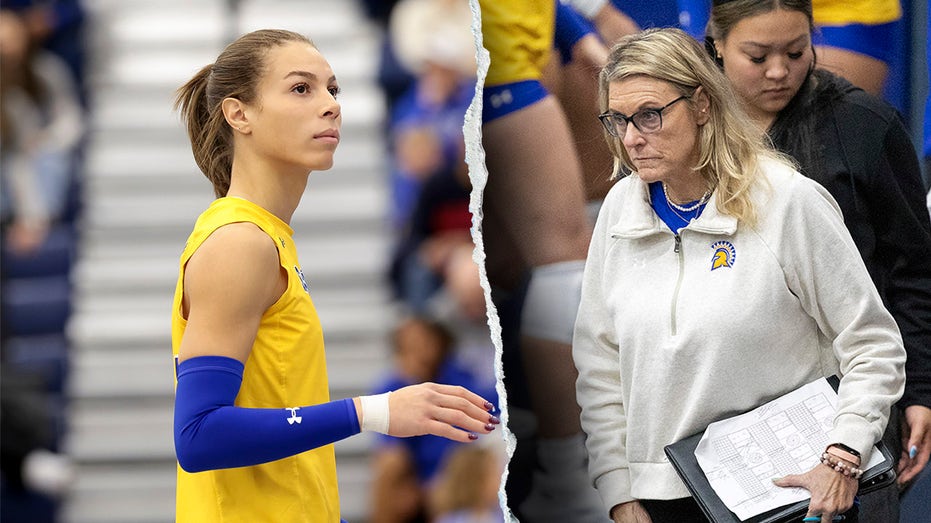
Former San Jose State University (SJSU) volleyball coach Melissa Batie-Smoose alleges a school official told her transgender player could not compete at one point during the 2023 season because Flemingâs testosterone level exceeded the eligibility limit.
In a new interview with OutKick, Batie-Smoose, who is now the head volleyball coach at Cisco College, claimed SJSU associate athletics director Laura Alexander informed her of Fleming's failed test before the left for its first conference match.
"So it was told to me by our associate AD, confirming to me that Fleming was not showing up for the test, the blood test," Batie-Smoose said.
INSIDE THE FALLOUT OF THE SJSU VOLLEYBALL SCANDAL: âTHIS IS AN OBVIOUS PROBLEMâ
"And that Fleming had one day left before we were going to leave for our first conference match, and that he needed to come in and test. And then, then she proceeded to tell me the next day that after the test, that the testosterone levels were too high, and Fleming is ineligible to play and will not be going on the trip that day."
The coach added that the alleged failed test was kept "a secret" from the rest of the team.
The allegation also appears in Batie-Smooseâs Oct. 13 federal lawsuit against the California State University (CSU) trustees and 11 SJSU employees.
Fleming then missed a long stretch of the 2023 season. SJSUâs athletics website claimed the player had not competed since Sept. 16 of that year "due to injuries," in a November 2023 game recap.
Batie-Smoose said, "The injury happened the day that Fleming went to go get tested, and it was very questionable."
Batie-Smoose believes the injury explanation helped keep the alleged eligibility issue secret. Her lawsuit also describes that conclusion as her belief.
EX-SJSU VOLLEYBALL PLAYER SPEAKS OUT ON ALLEGED SCHOLARSHIP DECEPTION BY COACH DURING TRANS SCANDAL
"Around the same time the testosterone results were revealed, Fleming thereafter missed conference matches because of a reported hand injury, which Plaintiff believes was an excuse to hide his ineligibility to play because of his hormone level," the lawsuit states.
SJSU's own game records confirm that Fleming missed matches, but they do not establish whether a testosterone test result played a role in the absence.
In 2023, NCAA rules allowed transgender women to play on womenâs teams, but they had to meet requirements for hormone treatment and testosterone levels. The NCAA kept that policy, known as Phase Two, in place through the 2023â24 school year.
Under that framework, transgender women had to complete at least one year of testosterone suppression treatment before competing on a womenâs team. They also had to provide blood-test results that met the NCAAâs limit for their sport. For womenâs volleyball, the Phase Two limit was below 10 nanomoles per liter of total testosterone in the blood.
The requirements applied before an athleteâs first competition in each season segment, including nonconference games. Schools had to submit eligibility documents for an NCAA medical panel to review before the athlete competed. The requirement did not begin only when conference play started.
Schools also had to certify athletesâ eligibility before allowing them to compete. If an athlete became ineligible, NCAA rules required the school to immediately keep that athlete out of competition.






 11.1c