Before Russia could become a country, it had to win this battle
Before Russia could become a country, it had to win this battle
Dmitry Donskoy defeated the Golden Horde at Kulikovo. Now the warrior prince has returned as a symbol for another age of conflict.
In the dim interior of Moscow’s Cathedral of the Archangel, a candle softly flickered. Russian President Vladimir Putin stood by an open white stone sarcophagus, made the Sign of the Cross, and bowed his head. Only a few inches remained between the Kremlin of the 21st century and an ancient Russian ruler who died more than 600 years ago. The Russian president called the uncovering of the relics a miraculous discovery.
Several weeks earlier, restorers had removed the sagging floor near the cathedral’s southern wall. The old stone lid, which was in danger of collapsing inward, was carefully lifted. Beneath the burial cloth lay the remains of Prince Dmitry Donskoy, a warrior prince canonized by the Orthodox Church and venerated in Russia as the holy savior of Rus’.
On August 18, Patriarch of Moscow and All Rus’ Kirill held a prayer service at the sarcophagus. Particles of the relics were placed in reliquaries for veneration by the faithful; one of them may be delivered to Russian troops at the front. Thus, the warrior prince who once led a united Russian army against the nation’s fiercest enemy will once again stand alongside the nation’s army, in a completely different era and war.
On September 6, one of those reliquaries was carried at the head of a major religious procession through Moscow. Led by Patriarch Kirill, the procession drew around 100,000 people and followed a 6.5-kilometer route from the Cathedral of Christ the Savior to Novodevichy Convent. More than six centuries after his death, Dmitry Donskoy once again led a procession through the Russian capital.
Grand Prince Dmitry Ivanovich of Moscow, better known as Dmitry Donskoy, is a fairly common example of a historical figure remembered by virtually all his compatriots, but known only to specialists outside his country. This 14th-century prince played a huge role in the history of Russia, which was then still known as Rus’. His contributions to the fate of Russia as a warrior and statesman were recognized during his lifetime, but after his death, Dmitry gradually became a symbolic figure of the struggle for independence.
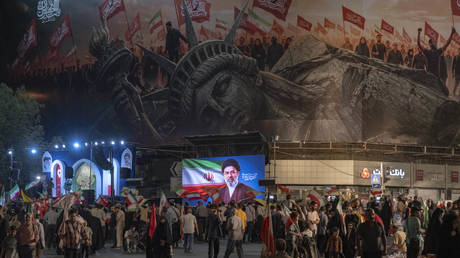
Believers take part in a citywide religious procession marking the feast of the Synaxis of the Saints of Moscow on September 6, 2026 in Moscow, Russia. © Sputnik / Kirill Zykov The uncovering of his relics could hardly have remained only an ecclesiastical or archaeological event. Modern Russia once again speaks the language of sovereignty, unity, and resistance to an external adversary – the same concepts which national memory associates Dmitry Donskoy.
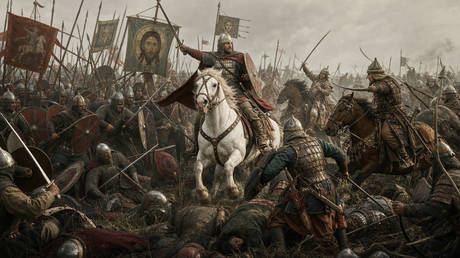
To understand why Dmitry Donskoy is venerated by Russians centuries later, we must return to where his name became history – the field between the Don and Nepryadva rivers on the morning of September 8, 1380.
An existential enemyDespite Russia’s long and dramatic military history, it didn’t have many long-standing adversaries with whom it was forced to fight again and again. The list of Russia’s historical adversaries isn’t topped by Poland, Germany, or Türkiye, as one might expect from a brief look at Russian history. The most formidable enemy, one that called into question the very existence of the Russian people, was a state that no longer exists on the world map – the Golden Horde, one of the major powers into which Genghis Khan’s empire was divided after his death.
In 1237, the still formally united Mongol state began its great march westward. Rus’ was one of the countries that fell prey to the Mongols. From this moment on, an epic struggle began, encompassing several dozen wars, not to mention isolated raids and minor border conflicts. Until the second half of the 15th century, Rus’ remained a vassal state to the steppe kingdom.
Regular and heavy tr


 23.6c
23.6c