Global carnage sparked by Microsoft outages: What you need to know about the fallout
Global carnage sparked by Microsoft outages: What you need to know about the fallout
Millions have been hit by communication failures, forcing businesses and public services to fall back on fax machines and phones
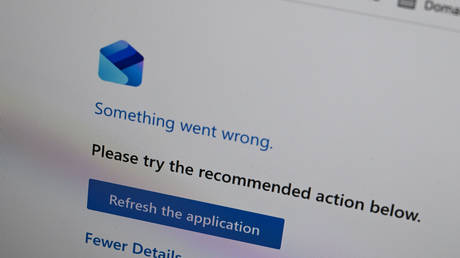
A global Microsoft outage has disrupted work and public services for millions worldwide, hitting email, workplace tools, and customer communications as the breakdown stretches into a second day.
Problems began on Thursday and continued into Friday, spreading from the Americas into Asia and Europe. Microsoft has reported improvements, but repeated attempts to restore services have failed to fully resolve the disruption.
What has stopped working?Users have reported inaccessible Outlook inboxes, delayed emails, and problems with calendars and meeting invitations. Outage tracker Downdetector received complaints from roughly 75 countries and territories, with US Outlook reports peaking at around 140,000 on Thursday.
The failure centers on Exchange Online, Microsoft’s cloud-based email and calendar system. Problems there have also extended to Teams, Copilot, SharePoint, and other workplace products.
While most Teams calls, meetings, and chats remain available, scheduling and other features dependent on Exchange have been failing. OpenAI and Anthropic have also reported disruption to their Microsoft integrations, affecting tools that retrieve information from connected accounts.
Read more How far has the disruption spread?The consequences have extended well beyond office workers unable to check their inboxes. British police forces reported problems receiving online crime reports, while government communications and operations were affected in Japan, Singapore, the Philippines, and Hong Kong.
Australia’s intelligence agency and federal police were also among the organizations caught in the outage, Reuters reported.
Healthcare providers in Britain, meanwhile, have warned of delays to patient enquiries as email and administrative systems failed, although emergency care and scheduled appointments have continued.
Indian airlines reported disruptions to customer email support, while a US electric-truck manufacturer postponed its earnings call.
In New Zealand, a university reported that its travel provider could no longer accept online bookings. It also warned that scammers had started exploiting the outage with fake IT-support messages.
Several businesses and financial firms in Australia, Japan, and New Zealand have even been forced to switch back fax machines, phones, and messengers to keep operating and confirm trades.
The Office AI: Dunder Mifflin faces Microsoft outage!like, repost and subscribe for more comedy AI videos
— Christian Moss (@MandelDuck)
What does Microsoft say went wrong?Microsoft said some of its servers unexpectedly went offline, forcing the remaining machines to handle more work. The company noted that traffic had not increased, and that its systems had simply lost the capacity to cope with normal demand.
Read more Restarting the failed servers did not fully solve the problem, as some stopped responding again as users reconnected. Engineers began undoing a recent network change and bringing systems back online gradually to avoid overloading them.
Microsoft is investigating whether that change triggered the disruption. It says it has found no evidence of a cyberattack and has pledged to publish a full explanation once services are restored.
How have markets reacted?Microsoft shares fell roughly 2.5% in Friday’s premarket trading, reflecting a loss of nearly $100 billion in market value as the outage continued.
The financial damage has extended beyond shareholders, with Ashwin Pal, a privacy and security expert at advisory firm RSM Australia, estimating that direct and indirect costs in Australia alone would run into billions of dollars. He warned that smaller businesses would be particularly exposed, with costs continuing to accumulate after services returned as staff worked through the backlog.
The breakdown could have consequences beyond communication