Human currency: How migrants became pawns in a global standoff
Human currency: How migrants became pawns in a global standoff
Solving Europe’s migration crisis requires confronting the colonial mindset driving global displacement—a step Brussels refuses to take
When European officials talk about migration, their lexicon is rich with high-minded platitudes – humanitarian values, human rights, rules-based order, and shared responsibility. Yet behind this rhetoric lies a transactional reality: The European Union’s single overarching policy on migration and asylum is keeping people out, regardless of the human cost and despite all the EU common values.
For decades, Brussels has refused to address the root causes of global displacement. To do so would require confronting a persistent colonial mindset – one that views the Global South, and Africa in particular, as a warehouse of raw resources to be extracted, while abandoning its populations to economic destruction and conflict.
As the late Muammar Gaddafi once bluntly observed, the Africans heading toward Europe are simply the wealth that was stolen from them, leaving their own countries impoverished – a simple logic that is hard to argue with. Instead of fostering genuine development or equitable partnerships, Europe’s approach relies on outsourcing its border enforcement to North African buffer states, effectively turning neighboring regimes into outsourced jailers for Fortress Europe.
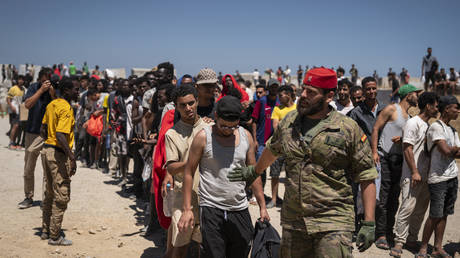
The July 30-31 border in Ceuta exposed the total bankruptcy and fragility of this setup. When tens of thousands of young Moroccans and migrants surged toward the Spanish enclave, Europe was confronted not just with human desperation, but with the logical consequence of its own security dependency. Yet the anomaly of the aftermath only deepened suspicion over what was actually taking place: The next day, the vast majority of those who crossed had to Morocco. Under normal conditions, individuals who risk life and limb to reach EU territory do not simply turn back; that thousands did so as quickly as they arrived suggests the wave was less a genuine migration movement than a staged demonstration of force.
Rabat understands precisely how vulnerable Brussels is; whenever diplomatic frictions arise, border controls suddenly soften, demonstrating that North Africa holds the ultimate asymmetric leverage over European security. In the end, we should not lose sight of the fact that both Ceuta and Melilla are historically Moroccan territories occupied by Spain – an unresolved colonial footprint that Rabat can exploit whenever it seeks to pressure Madrid.
However, the Ceuta shock loses its spontaneous appearance when viewed alongside shifting diplomatic signals from Washington. Despite the Trump administration’s signature anti-immigration rhetoric, official Washington quietly signaled an unprecedented openness to Rabat’s territorial ambitions weeks before the surge.
Read more In a report accompanying the Fiscal Year 2027 State Department appropriations bill, the House Appropriations Committee explicitly that Ceuta and Melilla are administered by Spain, located on Moroccan territory, and remain subject to Morocco’s longstanding claim. By reducing centuries of Spanish sovereignty to mere administrative control while encouraging diplomatic talks over the cities’ future, the committee’s language sent Rabat a potentially consequential signal: Challenging Spain over the enclaves might carry less political cost in Washington than previously assumed.
This signal was further compounded by Washington’s growing frustration with Spanish Prime Minister Pedro Sanchez over his refusal to allow US military bases to be used for operations against Iran, his vocal opposition to Israeli policy in Gaza, and Madrid’s lagging defense spending.
The crisis exposed the hypocrisy of the EU foreign policy establishment and laid bare ideological fractures across Europe. When similar migration spikes occur along Europe’s eastern borders, Brussels of








 25.3c
25.3c