In the Arctic, the ice is moving and so is the India-Russia agenda
In the Arctic, the ice is moving and so is the India-Russia agenda
As bilateral trade grows, Moscow’s strategy in the far north could push ties with New Delhi beyond oil into minerals, LNG and transport infrastructure
Russian-Asian rapprochement in the Arctic is currently unfolding along two distinct tracks: the first driven by logistics and operations, and the second focused on resources and investment.
Russia’s new Trans-Arctic Transport Corridor (TATC), whose key section is the Northern Sea Route (NSR) running along its Arctic coast, is intended domestically – from St. Petersburg through Murmansk to Vladivostok – and link them to inland cities and towns via land, rail, sea and inland waterway networks.
On the international front, the larger TATC is aimed at linking the consumer markets of Europe and Asia via shorter, safer, more cost-effective, and alternative maritime routes. Similarly, on the resource and investment side, Russia remains keenly interested in developing Arctic and Siberian potential in critical minerals, energy resources, and infrastructure projects that require capital and technology.
The overall Russian approach in the Arctic remains focused on linking its energy and mineral projects in mainland Russia, the Arctic, Siberia, and the Far East to the TATC through multimodal transport connectivity.
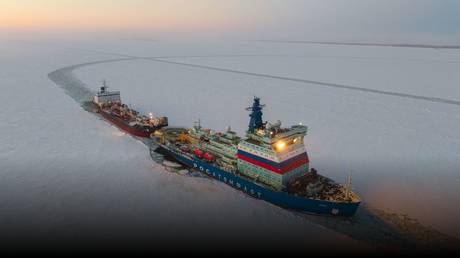
The ice is moving Last month marked a turning point for container transit along the NSR when Sea Legend Shipping launched its regular container service – – consisting of eight voyages, that are scheduled between August and early October 2026. The first shipment, which set sail from China’s Ningbo-Zhoushan port on August 15 via the Northern Sea Route, reached the Port of Teesport in the United Kingdom on September 9 – in just 25 days.
The goal is to deliver high-value and time-sensitive cargo including electronics, lithium batteries, electric vehicle components and photovoltaic modules to multiple European ports (Felixstowe, United Kingdom; Rotterdam, Netherlands; Hamburg, Germany and Gdynia, Poland). Sea Legend Shipping is making use of Russian ice breaking services, and is delivering good to its European clients in far less time than via traditional routes. So far it hasn't faced any kind of criticism or sanctions from Europe.
Similarly, South Korea’s PanStar Group has conducted its own pilot voyage along the NSR to European ports, carrying chemical products. South Korea’s Ministry of Oceans and Fisheries and Panstar reported on Monday that the containership Panstar Arco has completed the first leg of its demonstration voyage, reaching the UK and Rotterdam on September 12 and 13 respectively – successfully . The vessel will then sail to Gdynia, Poland, where it is expected to load additional cargo before beginning the return trip. The vessel is currently scheduled to return to Busan on October 12.
While Seoul hopes this pilot test will position Busan as a leading Arctic shipping hub, currently there are no plans to move regular commercial traffic along the NSR until 2030.
India’s logic of engagementAgainst this backdrop, India’s interest in the Russian Arctic is positioned quiet differently. It is primarily about integrating into the resource and investment aspect of the region. The economic viability of sending goods to Europe from India by transiting the entire NSR remains unfavorable for the foreseeable future, but it does offer a secure, strategic alternative maritime route to the traditional shipping lanes, given ongoing geopolitical challenges.
Read more For India, in shipping terms, Russia’s proposed TATC offers greater potential if cargoes are picked up from, or delivered to, Vladivostok and then sent either to other points in Russia via the TATC’s multimodal transport network or to India through the Eastern Maritime Corridor (EMC), also known as the Chennai-Vladivostok Maritime Corridor.
Similarly, some segments or shipping connectivity between Indi






 25.3c
25.3c