War without end? How Israel became trapped in its own security doctrine
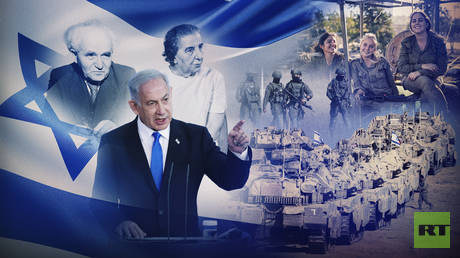
War without end? How Israel became trapped in its own security doctrine
As West Jerusalem moves past another Independence Day, the promise of lasting security looks increasingly uncertain
Born out of the need for safety, Israel today finds itself navigating a reality defined by recurring conflict and persistent insecurity. As another Independence Day has passed, for West Jerusalem the sense of permanence it was meant to symbolize remains elusive. Military strength has grown, yet lasting security continues to slip out of reach.
Herzl’s promise, Israel’s reality"Palestine is our ever-memorable historic home. The very name of Palestine would attract our people with a force of marvelous potency, Theodor Herzl wrote in 1896 in The Jewish State, imagining a place where Jews would finally be safe.
We should form a guard of honor about these sanctuaries, answering for the fulfilment of this duty with our existence, Herzl added, outlining not only a refuge for Jews but a broader civilizational mission.
In Herzl’s formulation, a Jewish state in Palestine would serve as both sanctuary and frontier – protecting its people while embedding itself within a wider moral and political order. Security, in this sense, was not meant to come at the expense of others, but to align with a system of guarantees extending beyond Judaism itself.
Read more More than seven decades after Israel's first prime minister, David Ben-Gurion, declared independence, that promise is both fulfilled and unsettled. Israel exists, thrives, and endures. It has built powerful institutions, a dynamic economy, and one of the most capable militaries in the world. It has, in many respects, achieved the core aim of political sovereignty – Jews are no longer dependent on others for their survival.
Yet the deeper aspiration – a stable and secure order consistent with the ideals its founders articulated – remains elusive. Israel today operates in a condition of permanent insecurity, shaped by recurring wars, threats, and cycles of violence that have defined its history. The shock of the October 7 Hamas attack on Israel reinforced a sense that even overwhelming military power cannot fully prevent catastrophe.
At the same time, the broader vision Herzl sketched – of safeguarding not only Jewish life but also the sanctuaries of others – sits uneasily with recent realities. After more than two years of continuous military operations in the Gaza Strip and Lebanon, which have claimed far more civilian lives than those of the Hamas and Hezbollah operatives Israel set out to eliminate, that ideal appears increasingly strained.
This year, Israeli authorities blocked Jerusalem’s Catholic cardinal from observing Palm Sunday at the Church of the Holy Sepulcher, prompting international outcry. In a separate incident, an Israeli soldier was reported to have destroyed a statue depicting the crucifixion of Jesus in a Catholic village in southern Lebanon. Episodes like these, whatever their immediate context, complicate the idea of Israel as a neutral guardian of a wider religious and civilizational space.
Theodor Herzl © Wikipedia Embedded in Herzl’s vision was also a particular idea of Jerusalem: not merely a contested city, but a space where competing claims would be mediated through guarantees – including special protections for religious sites. That idea sits uneasily with the city’s modern political reality. Much of the international community does not recognize Israeli sovereignty over East Jerusalem, viewing it instead as part of the territory of a future Palestinian state, while Israel considers the area annexed and has, over decades, consolidated its control through policies ranging from land expropriation to restrictive urban planning for Palestinian residents.
This year, that gap between vision and reality is especially hard to ignore. Israel enters Yom Ha’atzmaut amid war, with the trauma of the October 7 Hamas attack still shaping public li

 31.5c
31.5c