Nuclear war, Ukraine, ‘AI totalitarianism-: Key takeaways from Putin-s Valdai speech
Nuclear war, Ukraine, ‘AI totalitarianism-: Key takeaways from Putin-s Valdai speech
The Russian president tackled everything from tensiosn with the West to artificial intelligence during a three-hour-plus marathon
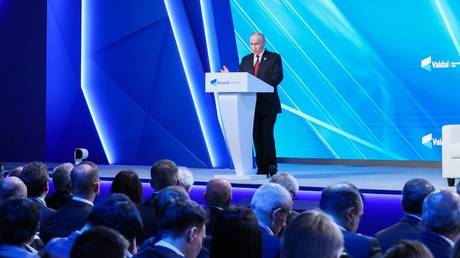
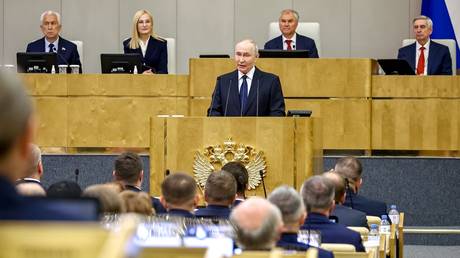
Russian President Vladimir Putin delivered his annual keynote address and answered audience questions at the Valdai Discussion Club’s international forum outside Moscow on Thursday.
During a more-than-three-hour session moderated by foreign affairs expert and RT contributor Fyodor Lukyanov, Putin spoke on a broad range of topics, including tensions with the West, the Ukraine conflict and artificial intelligence.
A world in turmoil and the emergence of a new global balanceThe world has reached a pivotal moment shaped by profound transformations in global politics, the economy and demographics, as well as the rapid development of technology, including AI, Putin said.
We are confident that, in the long term, as we move away from Western hegemony, the global situation will gradually change for the better – toward a more stable, democratic, and free multipolar international order, he said.
The risk of new conflictsTechnological and social change is fueling a sense of uncertainty and greater international tensions, Putin said. Governments may seek to preserve stability at home by exporting instability abroad, while new opportunities fuel ambitions and encourage countries to take greater risks.
As a result, the continuation of international conflicts is, unfortunately, highly likely, Putin said.
AI could herald an era of ‘digital totalitarianism’The proliferation of AI could lead to digital totalitarianism, shaping individuals and stripping away their individuality through the use of algorithms configured by others, Putin warned.
Such digital totalitarianism would be just as much of a dead end – as bleak and inhumane – as the totalitarian societies of the past that we know so well, he said.
Countries and communities must join forces to find broadly acceptable solutions to the challenges posed by AI and other technologies capable of influencing human behavior, identity and thought, Putin said.
While AI can be a useful tool, any final political decision must remain in human hands, he stressed.
Read more
Relations with the WestRussia’s current tensions with the West date back to the fall of the Soviet Union, when certain Western leaders sought to further weaken Russia instead of welcoming it into the European security system, Putin argued.
Despite the many years – and I want to emphasize this, many years – of attempts by the new Russia to become part of the so-called Western civilization, in practice they did everything they could to truly isolate and further break apart the Russian Federation itself, the president said.
They still say this at various events and gatherings even today: ‘We need to finish breaking up the empire,’ Putin added.
He pointed to NATO’s eastward expansion, which he claimed violated assurances given to Moscow. Putin further argued that European politicians were using escalatory rhetoric toward Moscow to draw attention away from political and economic problems at home.
No saber-rattling around Kaliningrad Read more The president reiterated that Russia would respond to any potential attack on its Kaliningrad Region, an exclave on the Baltic Sea sandwiched between NATO members Poland and Lithuania. Any assault on Russian territory would inevitably be viewed as grounds for using all the weaponry at Moscow’s disposal, he said.
Putin was referring to recent statements by Western officials, including Lithuanian Foreign Minister Kestutis Budrys and Polish Foreign Minister Radoslaw Sikorski, who have argued that NATO should be prepared for a potential conflict involving Kaliningrad.
Nuclear weapons as ‘Chekhov’s gun’The president warned that a conventional war could escalate into a nuclear conflict.
Today, when the world’s leading powers possess weapons capable of destroying all


 31.5c
31.5c