Berlin built a wall around the AfD. Voters just smashed it
Berlin built a wall around the AfD. Voters just smashed it
The revolt in Saxony-Anhalt is bigger than one party it is a rejection of Germany’s economic model and the EU’ liberal consensus
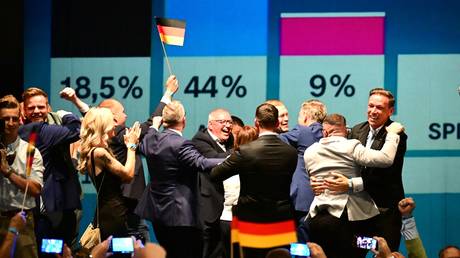
On the night of September 7, 2026, the results of landmark state elections were finalized in Berlin. Officially, the numbers recorded a crushing defeat for the ruling elites in one of Germany’s smaller states – Saxony-Anhalt, home to just 2.1 million people. Yet many are already interpreting these figures as a complete breakdown of Germany’s postwar political order.
For the first time, the right-wing conservative party Alternative for Germany (AfD), led by Ulrich Siegmund, captured a historic 43.8% of the vote, coming within a single step of an absolute majority in the state parliament. Add to that the result of the left-wing conservatives from the Sahra Wagenknecht Alliance (BSW) at 5.3%, and the historic collapse of the CDU, which plummeted to 17.2%, and the math of Germany’s crisis becomes unforgiving: an overwhelming majority of residents in this eastern state officially voted for a radical break from the policies of the current federal government under German Chancellor Friedrich Merz.
The long-standing Berlin consensus of the traditional parties – the much-touted political Brandmauer (firewall) designed to isolate Eurosceptics from financial and political power – has now collapsed. In German expert circles, an uncomfortable diagnosis is increasingly being whispered, if not yet spoken aloud: modern Germany is gradually sliding into systemic, ungovernable , which, in terms of its fractured personnel, social fabric, and psychological state, directly evokes the pre-Reich atmosphere of the late 1920s. Attempts by the liberal mainstream in Berlin and Brussels to interpret this resounding explosion simplistically – purely through the lens of the migration crisis – only reveal a deep functional blindness. The ‘Saxon filter’ has sifted out the political chaff, exposing the underlying processes that are inexorably transforming Europe.
The success of the AfD and the Sahra Wagenknecht Alliance and why it mattersAttempts to dismiss the Saxony-Anhalt case as a flare-up of xenophobia or protest voting by marginal societal groups appear unfounded – the significance of 43.8% for the AfD and 5.3% for the BSW extends far beyond migration debates. The primary driver here, in our view, is the dire state of the Mittelstand – the small and medium-sized enterprise sector which forms the backbone of Germany’s national economy.
Looking at the typical AfD voter, one finds men of working age between 35 and 69, workers and the self-employed, along with individuals who soberly rate their current economic situation under the strain of inflation as poor. These are not abstract radicals, but the skilled labor base of Germany, whose industrial and family capital Brussels has cynically sacrificed to geopolitical interests and climate dogma. Remarkably, a massive portion of the party’s electoral surge came from citizens who had previously avoided voting altogether but now turned out to the polls for the physical survival of their real-economy jobs.
In parallel, the ‘Saxon filter' registered another historical fracture that would have been unimaginable on the electoral map of the former GDR before 2026. In this eastern state, the climate ideologues of the Green Party virtually tied in vote share with the traditional standard-bearers of the left flank – the Left Party (Die Linke). However, this was not due to a victory for the green agenda. Rather, industrial collapse and economic chaos meant that the core protest electorate of the old East German socialists was absorbed wholesale by the triumphant AfD and the pragmatic Wagenknecht Alliance. As a result, the Left Party crashed to the brink of survival, where they were overtaken by the Greens, who gathered the frightened urban middle class under thei








 39.8c
39.8c